#75: Oman and Qatar, February 2012
Let’s Get Away from It All, Part Two
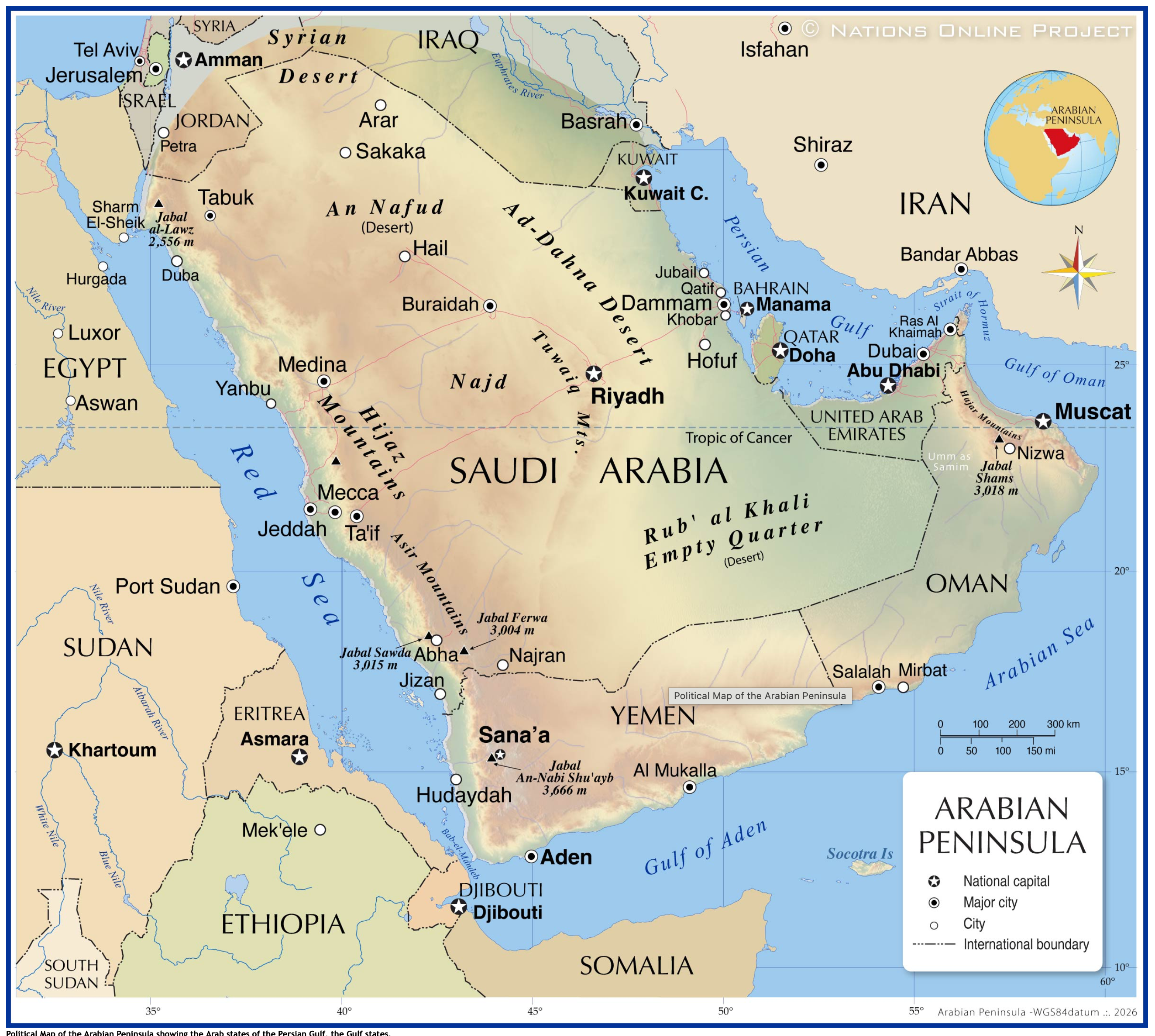
20 February
We finally arrive at Wahiba Sands Camp off a narrow tarmac road through the desert — an exotic sight against the lowering sun. But a closer look is disappointing. It’s really down-scale and down on its luck. We later learned that it was originally designed for adventure tourists, but the paving of the road has hurt that business. Adventure tourists want less, and other tourists want more. Palm-frond huts offer bare-bones accommodations — grotty, grubby, with slanting plywood floors covered in assorted ripped linoleum. Our minimal but private bathroom is reached via a pathway of rotting sandbags soon to be under a starry sky. We don’t need the Taj Mahal, but a little more would have been preferable. Oh well, it’s not as bad as the Hotel Musoma, always my nadir of comparison. (See Post #4: Starting the ELCT Film, 1974-1975).
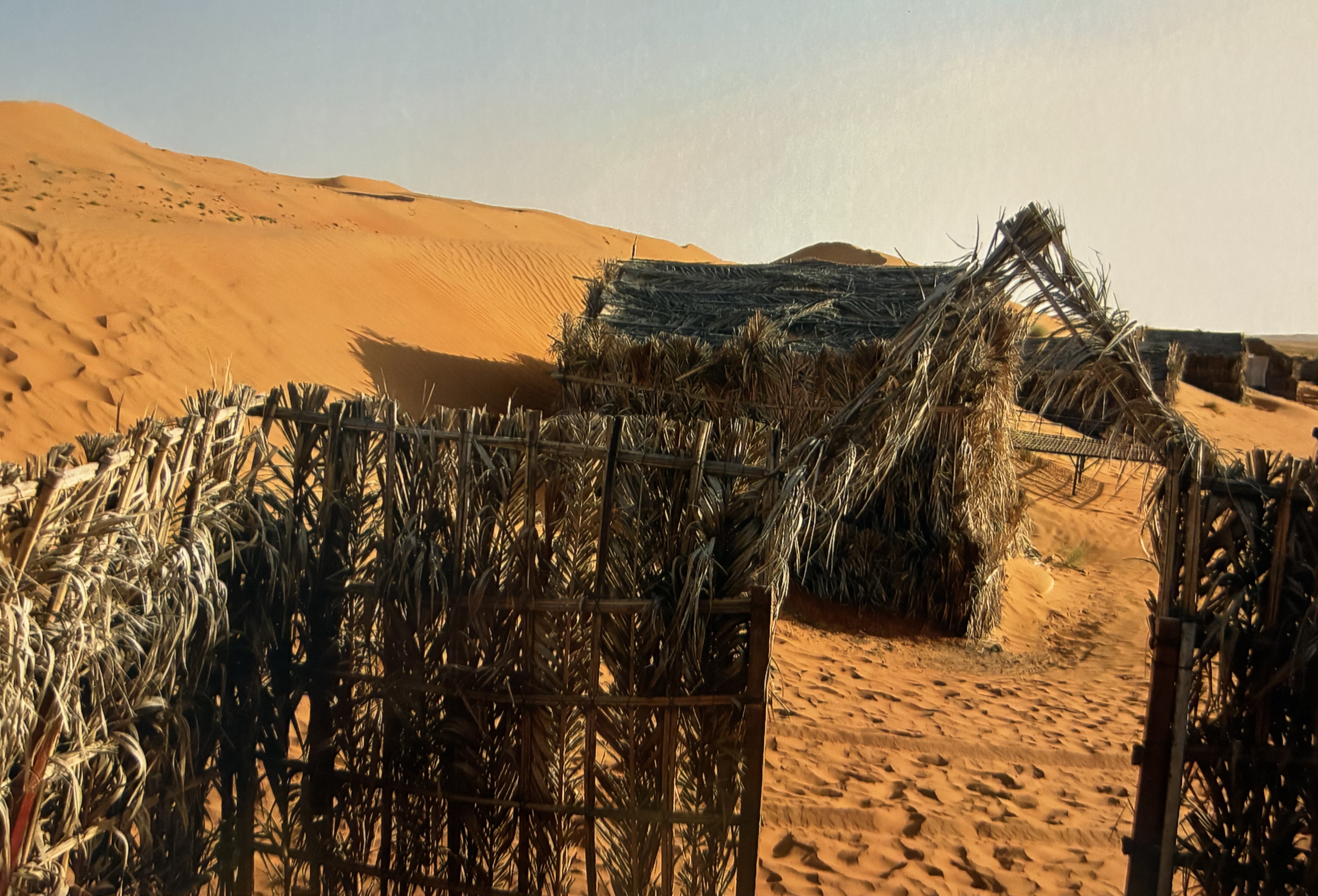 The reason we’re here is to experience one of the great geological formations on the planet. The Wahiba Sands cover over 10,000 sq. km. of the eastern Sharqiyah, described by Nigel Winser, project director of the British Royal Geographic expedition in 1985, as “a perfect specimen of sand sea.” One reason we chose our camp was that it’s on the edge of the tallest dunes, which soar upwards of 60-80 meters. The dunes are believed to have existed before the last pluvial period in Arabia around 4000-6000 years ago, and their sight doesn’t disappoint.
Russell goes off with Abu and son for some “dune-bashing” as it’s unhappily termed. I can see the dunes perfectly from camp. Feeling no need to conquer them by four-wheel drive, I stay back to prep for our 8 a.m. departure the next day.
==============================================================
Russell’s Report of Dune Adventure
The original plan for our 4×4 excursion across the high dunes was to use an expert, local driver in the expert’s jeep. But Abu insisted his SUV could go anywhere with him driving, so the camp staff let some air out of his tires for better traction, and off we went.
Pride goeth before a fall; before long, we were deeply imbedded in soft powder drifts. Abu rocked the vehicle back and forth, only succeeding in sinking the wheels deeper and deeper. Finally, he gave up and sent his son back to camp for help. When the rescue crew asked Abu why he hadn’t followed the trail-marker flags, he replied with a shrug, “I did for a while, but they petered out.” Even with five men, a winch, a chain and another powerful vehicle, extricating our SUV took 45 minutes of sweat and strain.
Abu insisted on continuing to drive across the dunes. I countered that he take the short route back to camp. We paused long enough to enjoy the sunset from atop a dune-ridge, then he headed straight down a harrowingly steep slope until we reached level ground. “Don’t worry,” my self-confident chauffeur blustered, “Nothing can happen.” Why was I not reassured?
==============================================================
RB safely back from his adventure, we get cleaned up and go for dinner in a sand-floored, rustic pavilion, a not-bad buffet of curried veg, lamb, rice, hummus, flat bread and . . . Pepsi! Our fellow guests are French, British and American, all on some type of “adventure” trip, so they’re fairly happy, feeling they’re roughing it in the desert. We wonder if we should have booked the other safari camp on the internet — Bedouin tents with rugs. It’s located much farther from the high dunes and seemed a bit fake at the time, but so’s this, in its own way.
We return to our palm fronds and read while drums, oude and singing sound in the distance. At 10:30, the generator kicks off, and that’s it for the night, whether reading or singing.
21 February
Up at 6:30 after a good night’s sleep for both of us. Only one trek across the dreaded sandbags for a night-time whiz, so we didn’t have to suffer much. Very cold shower with just a trickle of brownish water, but we manage to get clean enough for breakfast, reached through a sea of fog which has descended on the desert. Food’s disappointing after last night’s dinner — local version of Wonder Bread, hard-boiled eggs, tea, seriously icky banana. Then off we go, thankful to be away.
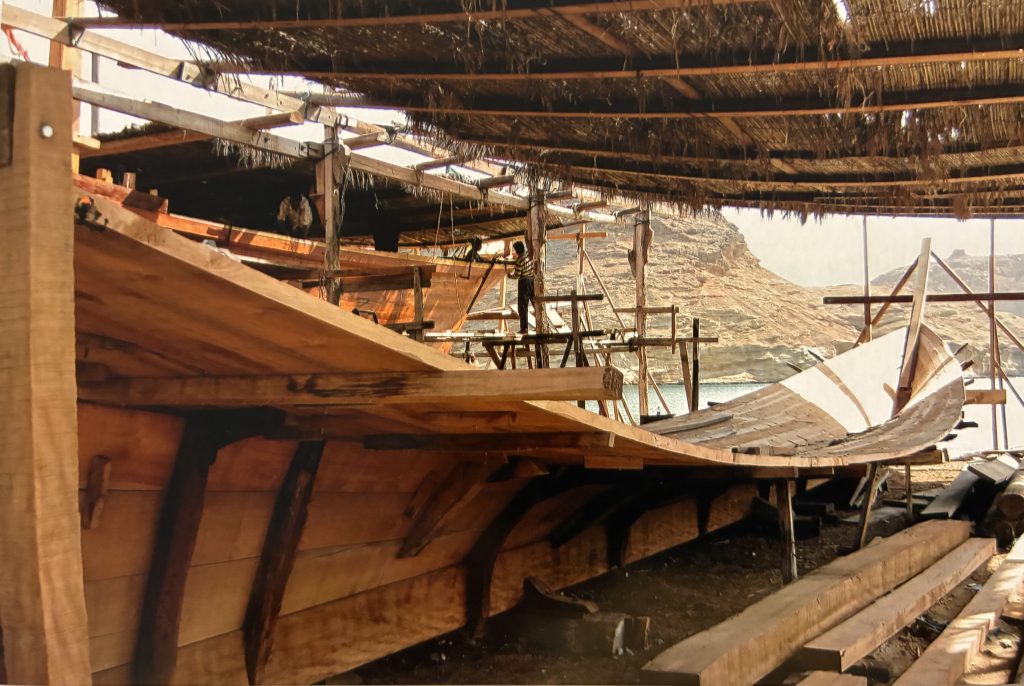
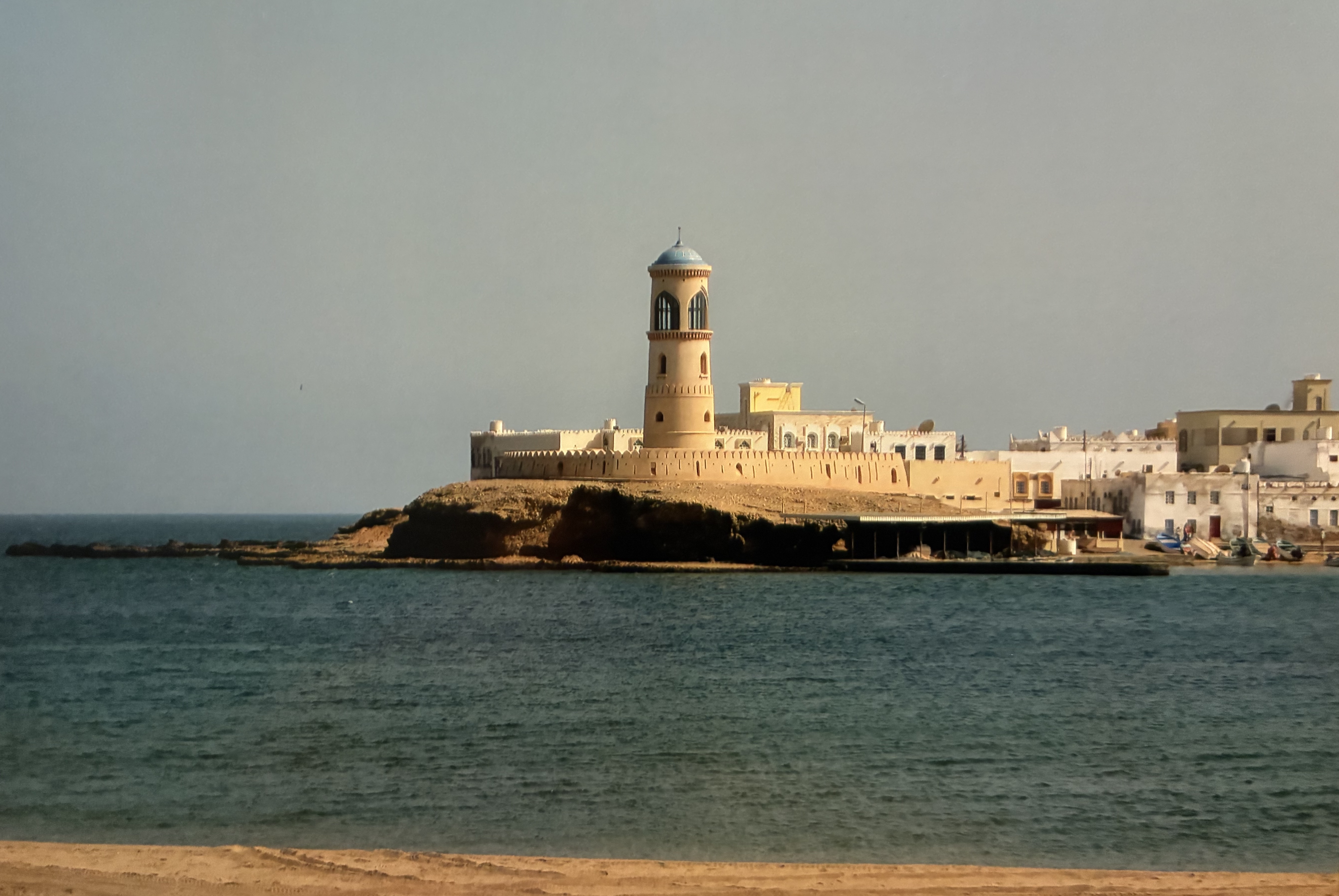 We drive about an hour-and-a-half to Sur, where we have tea and biscuits on a terrace overlooking the harbor. Then up the street to the last dhow shipyard in Oman, a country which used to produce hundreds of dhows each year. Now, the workmen aren’t Omanis, who’ve forgotten the skills, but imported Indians. Even so, it was fascinating to see these giant, sea-going boats of wood built by hand in the ancient way with just simple, non-power tools. Farther along the coast, but still in Sur, we saw a courtyard with an exhibition of old dhows and a dhow museum not yet open but full of promise.
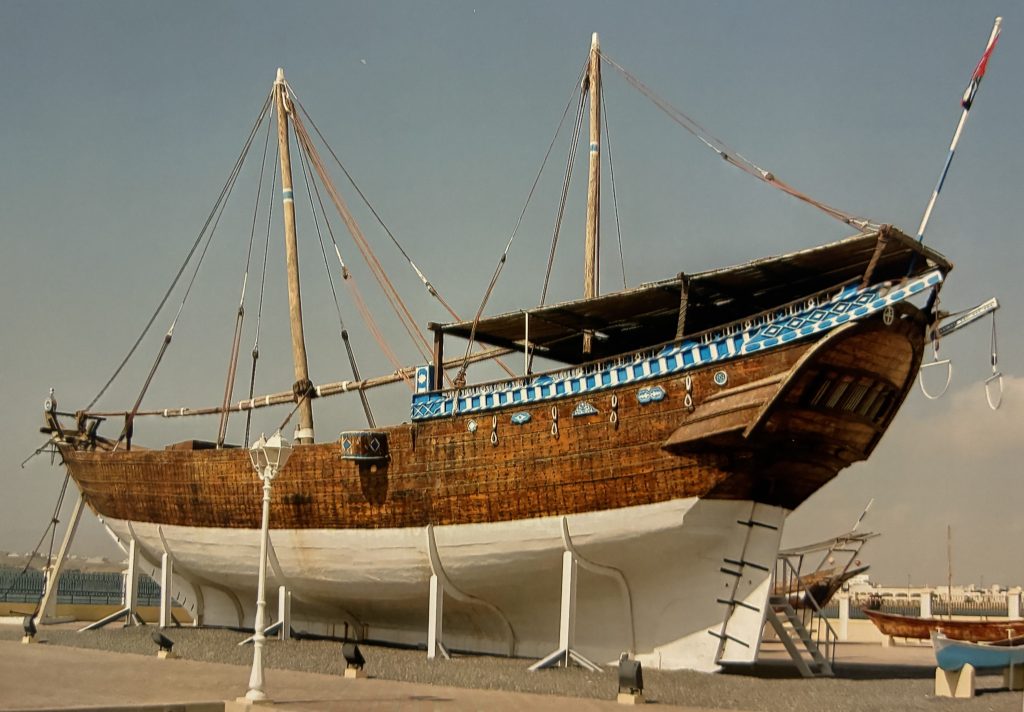
On to Muscat, traveling along the coast, then inland through Hajar. Abu turns off the four-lane highway and takes us on a dirt road through Wadi al Lahlu, one route for the Oman Rally. Fascinating formations, greenery here and there where sea mist gives just enough water for plants. Then into Muscat and home to L’Espace. We sit on the terrace for a bit with Abu, who thanks us for the trip and says he’s learned a lot from us — the ultimate accolade from this proud, brave, knowledgeable man, one feels.
Samosas, lamajoon and salad for lunch. Unpack. Rest. Read. Out to dinner at a Turkish restaurant — mixed appetizers, lamb kebab for R, giant grilled prawns for me, all washed down with mint lemonade granité.
22 February
Didn’t set the alarm, so we wake up at 7:30. Rush to shampoo, iron NS shirt, etc. Fortunately, RBS has clean, ironed shirt and took a shower the night before. A quick breakfast, talking with Wisconsonites at next table, who’re thinking about moving out of U.S. and therefore interested in our life experiences.
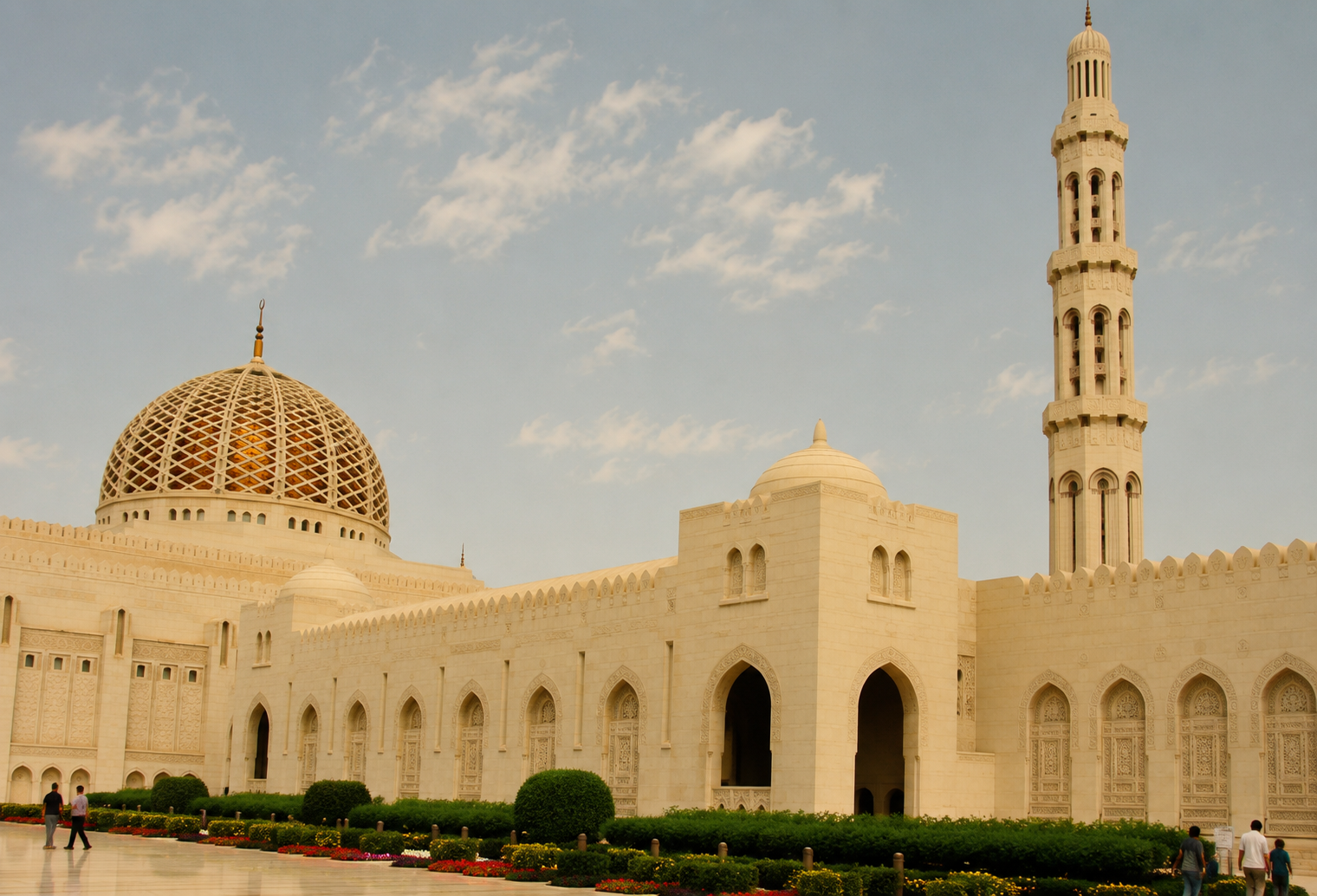 Nasser picks us up at 8:30, and we drive to the Grand Mosque. And it certainly is. We find we prefer the ladies’ prayer hall to the over-done main hall, which holds 6000, as well as more bright tile-work and crystal chandeliers than we’ve ever seen in one place. Off to one side of the main building, a real highlight, is the portico with tiles depicting different styles from across the Islamic world. We have a nice encounter with one of the mosque guides, his lined face full of dignity, and with the lady who runs the library. Both speak English, and we exchange views on all sorts of things.
As we are leaving, hundreds of cruise ship passengers arrive, many of them inappropriately dressed, ditto their behavior. Makes you ashamed to be a foreigner. Thank God we had the place mostly to ourselves. A good reason to go as early as we did.
We head back to the house so I can shed loose trousers for a longish skirt and leave my headscarf behind. I don’t mind being covered while at the mosque — it’s a sign of respect — but I want to wear my normal togs for the rest of the day. Beginning at the Natural History Museum, where the ever-present coffee shop isn’t. So we cross eight lanes of traffic (some of it on an overpass) to the City Centre Hotel, where we have pretty good cappuccinos and nice pastries. Then back across the eight lanes to the Museum. Exhibits a bit old-fashioned, but well-done in terms of information and illustration. Especially liked the natural history of where we’d been upcountry and the display about efforts to reintroduce the Omani Oryx back into the wild, thanks to a breeding program with stock from the San Diego Zoo. Also an interesting exhibition about local wolves, which may be the precursors of the domestic dog — they look rather like light-colored German Shepherds. Wonderful insects, huge spiders, scorpions and wild cats, some of which may no longer exist (at least they haven’t been seen in some time). Geology fascinating — igneous and sedimentary rocks (limestone, shale, chert) upended by tectonic plates, including a nearby India once upon a time.
On to the souk, where I happily find a cotton caftan for sleeping, then to nearby Kurkum Restaurant for best meal so far — salads of (1) mango, pineapple, chickpeas and coconut and (2) chicken tikka with greens. Share homemade chocolate ice cream and had loose teas of Earl Grey and Darjeeling. Inventive menu for dinner also. Too bad we only discovered this place on our last day. Would highly recommend it, though it shows up nowhere in guidebooks or online travel sites.
As we prepare to leave for Doha, I have an insight about how Oman pulls our lives together. Many of the places we’ve lived and worked — Tanzania’s Zanzibar, India, Pakistan, Somalia, Sri Lanka — all have historic connections with Oman. The Omani were there before us, and we follow in their footprints.
23 February
Up at 6:00 for final breakfast at L’Espace, inviting the Samji family to visit us in Italy. With Nasser to airport. Easy check-in. Cappuccinos in duty-free area. Smooth flight despite crew predictions of turbulence. Read Michael Connelly’s The Reversal like there’s no tomorrow, just in case.
Amazingly easy arrival procedures at Doha Airport — photo taken (or was that an iris scan??), pay for visa and walk away. What a contrast with experiences in Muscat.
Hotel car waiting, and we’re whisked to Hotel Souq Wasif, where we get an upgrade to a deluxe room (22′ x 13′ with giant marble bath). Rather strange, dark decor — maybe a reaction to the bright sand and sea outside? It truly is on the edge of the souk and seems to be created from one of the larger souk buildings. Good use of local architecture and decorative motifs but not over-the-top. Turns out to be one of the few traditional areas left in Doha — like Dubai, a shame to lose heritage.
We unpack and have a nice lunch in the restaurant, which has the rep of being the best in town for seafood. I try shrimp tempura while Russell has fish and chips, neither of us disappointed. Check emails after lunch and have a little rest. Then out to City Centre Mall for some shopping. No luck with continuing search for sandals. Good luck with Advil, vitamins. No luck at the French multinational chain, Carrefour (which seems to be going downhill); e.g., no vanilla or baking powder. Finding our way around the mall is tough — no brochure with floor plan. Have to go to each floor and check directory for what’s on that level. Or ask the staff at the information kiosks, who are distinctly unhelpful and even hostile. Feeling queasy. Find a decent bookstore and buy some trail books — Jeffrey Archer and Orson Scott Card. Dinner at noodle place in the mall — stir-fried tofu and beans for me, noodles with beef tenderloin for R. Both taste great. Taxi back and so to bed. But queasy and gaseous all night long.
24 February
Hotel breakfast offers choice of continental, American or Arab. I’m for continental — nice basket of assorted breads plus OJ, tea. Still queasy.
We walk around the souk and find it the best so far. It’s much larger than those in Muscat and Nizwa, with interesting architecture and a variety of shops, the further in, the less touristy. It’s been renovated in recent years and done with a careful hand. Best section is the one with animals — birds of many types, rabbits, puppies. Lots of people buying birds in small cages — to take home for the song, we hope, not to eat like they do in Umbria. However, there’s cock-fighting in this area, and we walk by at a rapid clip. We happen upon a shop run by an ancient body-builder, complete with blown-up photos of when he was young — all a bit camp, but it’s nice to meet someone who’s lived his passion.
All around the souk and our hotel is clear evidence of super high-rises going up (160 new ones to be built by 2020). This special neighborhood will be overwhelmed in months, it seems.
Because it’s Friday, most places are closed, so we decide to go by taxi to Villagio Mall on the outskirts of the city. Shopfronts constructed like an Italian village, ceiling painted like the sky, even a mini-canal with a gondola and an ice rink filled with aging Anglo hockey players. But you can see why, in a climate so demanding most of the year, creating this artificial environment makes some sense. We have a cappuccino and a palmier au chocolate at Paul’s, a bistro set in the middle of one of the wide corridors, then on to this mall’s Carrefour with the same bad luck. Still no luck with sandals and still queasy.
Suddenly, bad gas pains, followed by embarrassing flatulence. Thirty minutes later, I’m in the ladies room, thankfully ridding myself of what ails me. Not serious and bringing relief. Hard to know what done me in, but I feel better getting it out.
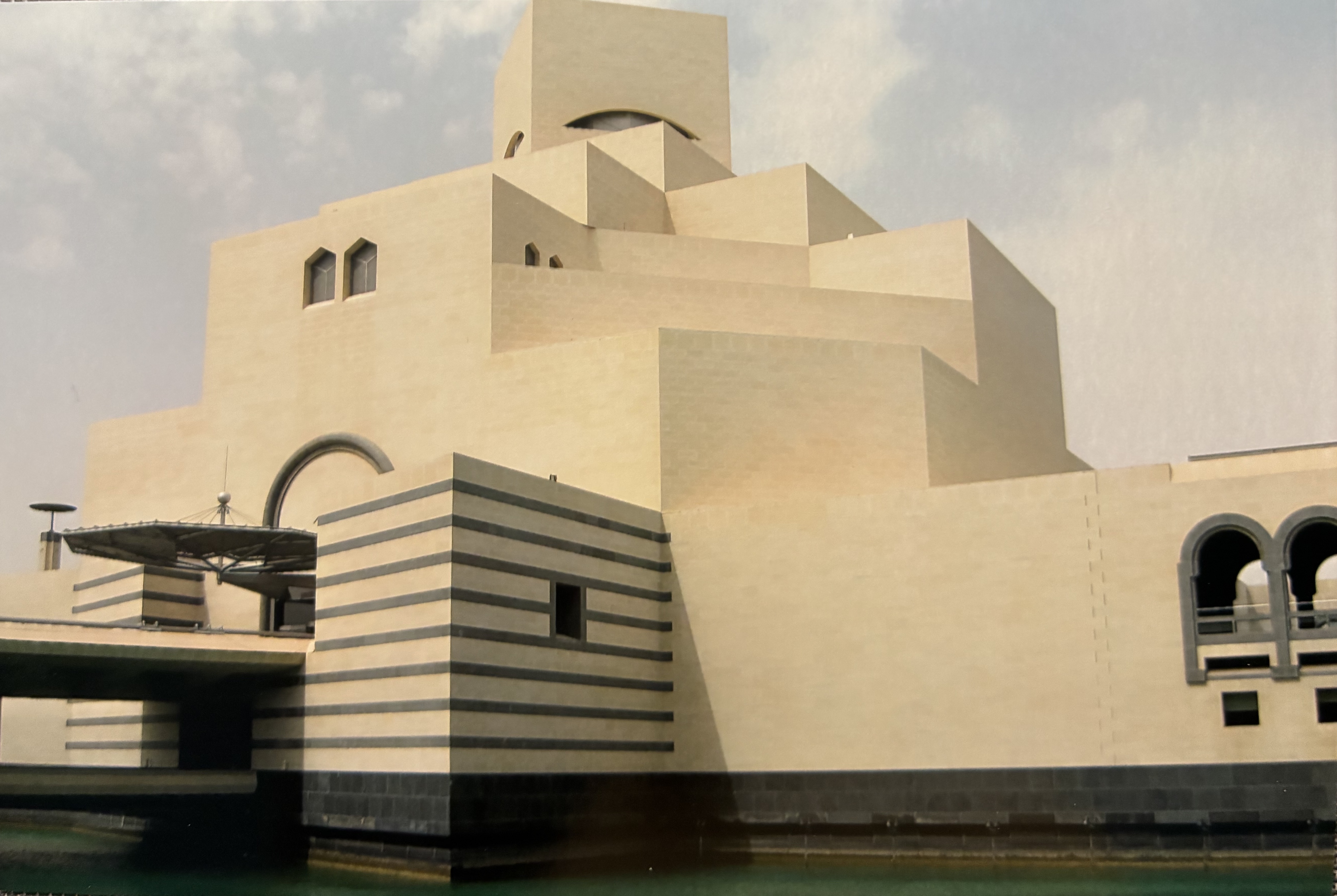 Now that it’s afternoon, the Museum of Islamic Art (one of the main reasons we came to Doha) is open, so we grab a taxi and walk up the ramped garden to the Museum entrance. Wonderful building designed by I.M.Pei like a modern version of a traditional fort rising on an island built in the harbor. The emir’s family has been collecting Islamic art for decades, and they hired one of America’s greatest architects to design the right setting. The whole thing really works — the building and the collection. We split up, each to focus on a different floor, so we can see with our own eyes, then share reactions, insights, etc. After two hours, we’ve visited only half the collection, so we decide to come again the next day.
Still queasy as we walk back to our nearby hotel to rest up for the evening. The usual medical advice for GI tract problems is to allow the body 24 hours to fight on its own, and that usually works. But not this time, so I pop a couple Pepto Bismal, hoping to get by with a little help.
Dinner with long-time English friend from Amelia, Ruth Tessara, visiting her son Thomas and his wife Lamriya. We’ve reserved a table at our hotel’s restaurant for all of us. A nice evening of conversation and learning what it’s like to live in Doha, where T&L have been for some five years. He has a film-production company, and she works for the Ministry of Sport. They met while they were working on the Asian Games, and the rest is history.
25 February
Up at 7 a.m. for nice breakfast. Then through souk and up to Al Kost Fort, which has been renovated by a European architect and reported to have an exhibition of textiles and costumes. Locked up tight, but vacant lot next door is full of adolescent camels, so all is not lost.
Decide to go to Photography Museum instead. Take taxi to hotel nearest Museum and discover no one has heard of it, and the nearby Museum of Natural History is closed for the third time in ten years (!).
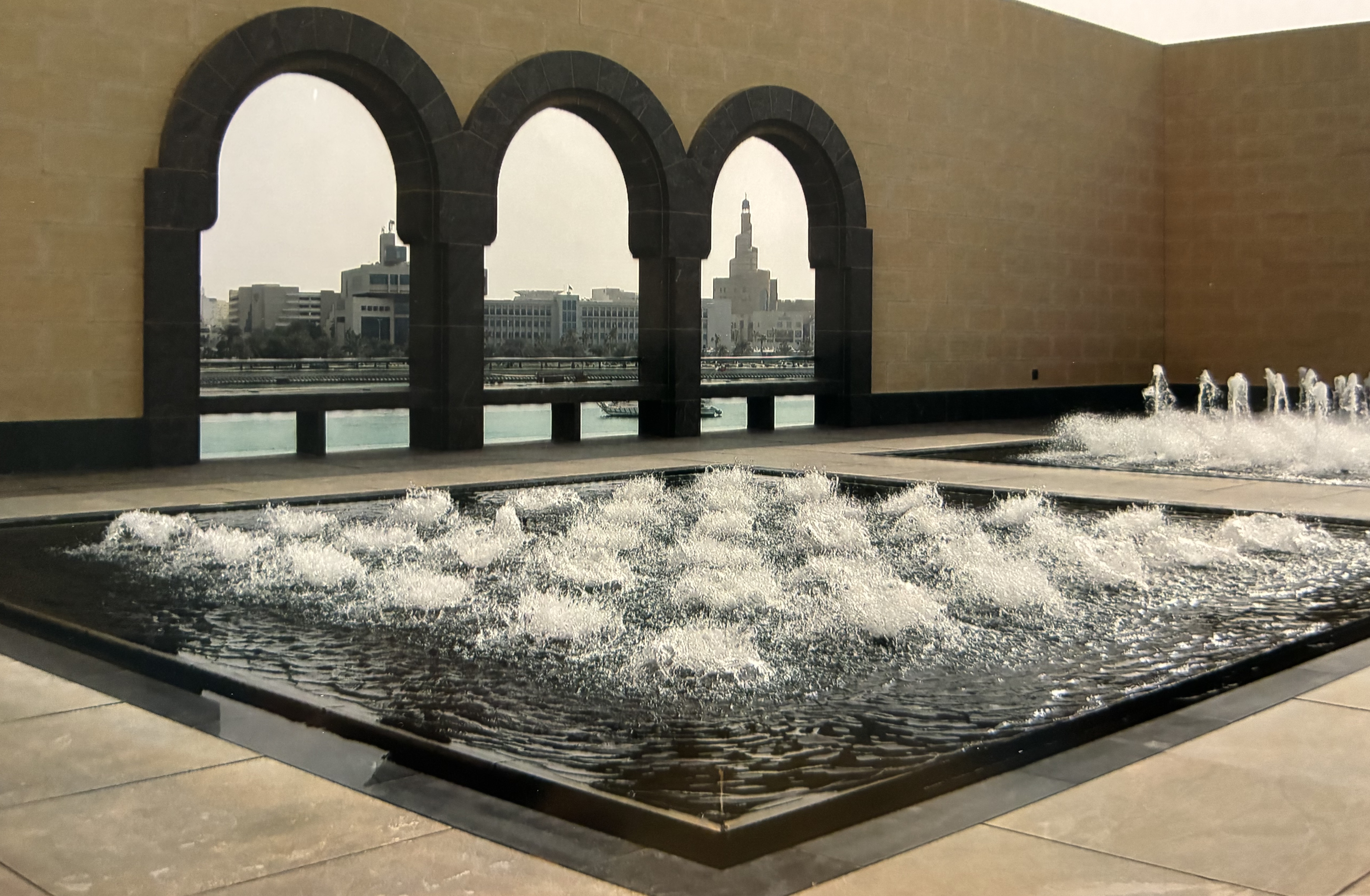 Rather than risk another disappointment, we walk to the Museum of Islamic Art, only to be accosted (that’s the right word) three times by “guards” because the Museum is not yet open. We already knew and only wanted to walk around the grounds until opening time. We manage to do that, taking some pix and then go inside to visit the exhibits we missed yesterday.
During our four hours spread over two days at the Museum, we were enchanted by the displays of calligraphy, pottery, metalwork (including marvelous helmets with high, sharp points), ceramic tiles, painting, clothing, rugs, scientific instruments from the 7th to the 18th centuries and across the Islamic world from North Africa and Spain to Central Asia. Many of these types of items we’d seen before, so it was like greeting old friends, but the quality of the collection is just astounding, and we’d not necessarily seen that before. One criticism — the gift shop has only high-end items or low-end, touristy stuff. They could learn from other museums, offering things in the middle range — good reproductions, inventive use of artistic motifs, etc. Ah, if only I were younger…
We pause halfway through our tour for lunch in the museum cafe. Creative sandwiches — saffron lamb on ciabatta, mixed veg on focaccia with sea salt and fennel. Afterwards, we split an excellent tarte au citron with our tea.
Back to hotel and sleep like the dead, seemingly dealing the final blow to the tummy problem. Call Thomas 2-3 times with no answer. He returns our call, and we give thanks all around — especially for the delicious local chocs that Lamiryah brought the night before. Chatted with Ruth a bit. Then had dinner at hotel with queasiness all gone. Pack and so to bed for return to Italy the next morning.
Talking the trip over, we figure we spent too much time in Doha, given how many sites of interest were closed. If we had it to do over, we’d add another week in Oman, seeing more of the country, including the northern nature reserve, staying at least another night up in the Green Mountains and come to Doha mainly to visit the Museum of Islamic Art.
~~~~~~~~~~~~~~~~~~~~~~~~~~~~~~~~
Now, looking back fourteen years to that visit, we feel lucky to have experienced Oman and Qatar when we did, while there were still traces of traditional culture and life. Who knows what current events will bring to that part of the world? I can only imagine how much that we encountered has been lost.