#74: Oman and Qatar, February 2012
Let’s Get Away from It All, Part One
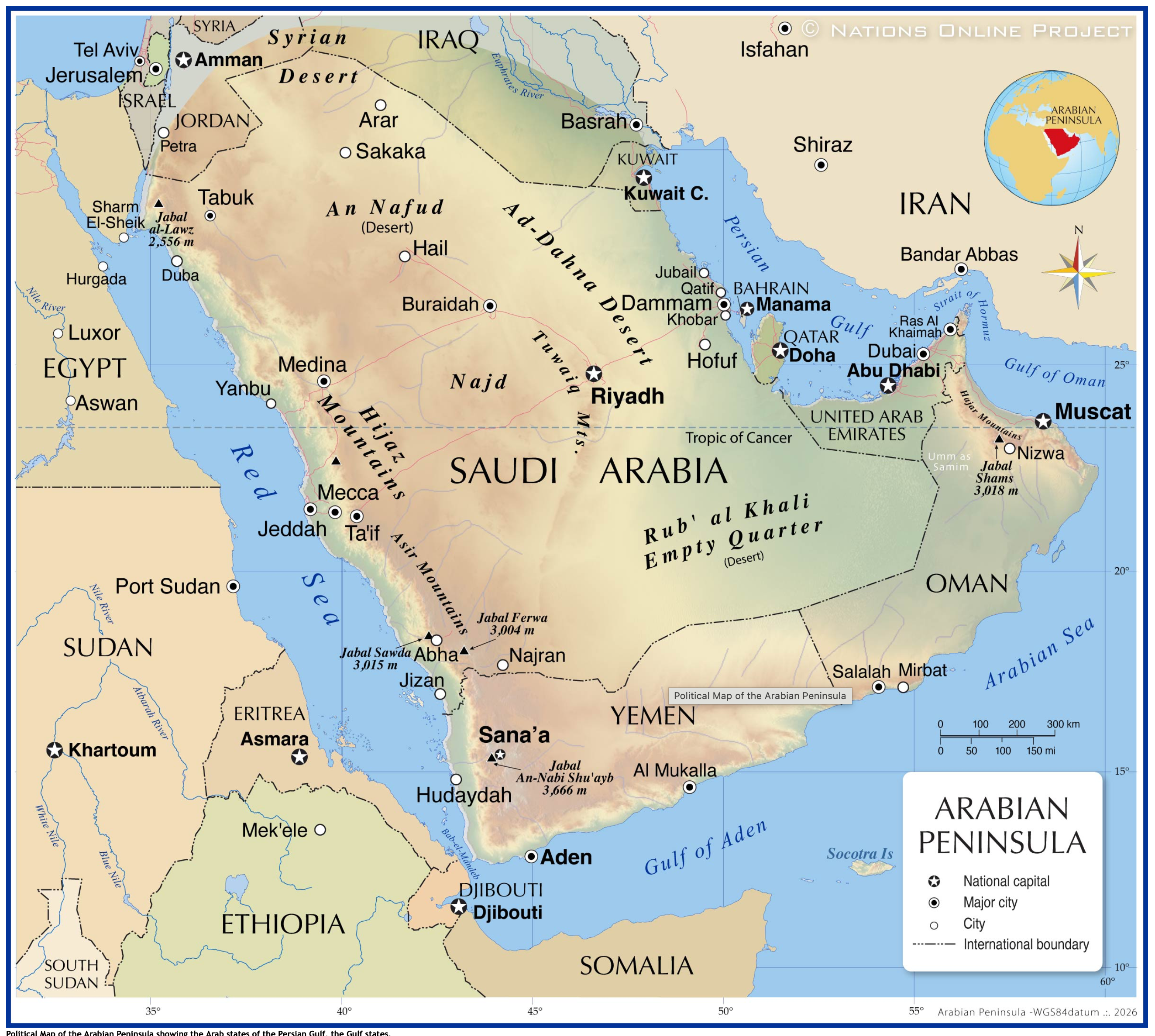
16-17 February
What a difference a good beginning can make to a trip. Pack during the morning, while Russell takes Aika to the kennel. By the grace of God, it’s the first day that a taxi can make it down and back up our road through melting ice and snow. We leave home at 2:30, take the train from Orte to Fiumicino, have dinner at the Hilton, get our bags shrink-wrapped (always a good idea when there’s a layover between planes) and check in for our flight to Doha. Take off at 10:30 p.m. and arrive at 5:20 a.m., local time (two hours in advance of Italy).
We get a latte macchiato and a croissant, knowing we’ll need the energy. It’s only an hour flight to Muscat, but it seems like forever in the airport, first in a long line to pay for our visas, then another long line to get passports stamped. Required photos in fact not required so rush to Terni a couple days before departure in order to get pix hadn’t been necessary after all.
Taxi to our B&B, L’Espace, a post-colonial villa by the Persian Gulf with nice staff; amazing, giant curving staircase that seems to take up a fourth of the house-volume; good-sized bedroom with an outdoor terrace featuring banquettes covered in local fabric and looking toward the sea.
Fairly peakéd after the overnight flight, so I have samosas and salad for lunch, while R opts for Lebanese pizza and salad, both with freshly prepared mint-lemonade, wonderfully refreshing. We pull the heavy drapes, turn on the a.c. and snuggle under the duvet for a nice nap. Then up and at ’em by taxi to the neighborhood of Muttrah to visit the souk. Entry-area shops aimed at tourists and therefore pretty poor stuff, further back aimed at local folk’s personal and household needs. Most local women are in some form of cover-up, all the way from the black abbaya and headscarf to veil or mask revealing only the eyes. Local men mostly in long, white dishdasha and embroidered skullcap. Dined sitting on the terrace of a Turkish cafe over the souk entrance — hummus, baba ganoush, vine leaves, chicken kebab. Tasty and light, just what we needed.
18 February
L’Espace is a great place to stay, not least because of the family which owns it, like many Ismaili Muslims, they have a peripatetic history. Sofia, the wife and manager, is the granddaughter of a man who drove a taxi in Nairobi. Her father moved the family first to Burundi, then to Belgium and finally to Canada, so Sofia is fluent in French as well as English. She and husband Maurice decided to start a new life outside Canada, which they thought was too materialistic, so they visited first Dubai (too trash-and-flash) and then Oman, which they decided was a good place to raise children. Once the kids were old enough to go to school, Sofia was languishing for something to do, so she scouted around, found this house, moved the family in, and started a B&B with the extra six bedrooms. We liked the family so much that, when we left, we gave them our contact info, inviting them to come visit us in Italy.
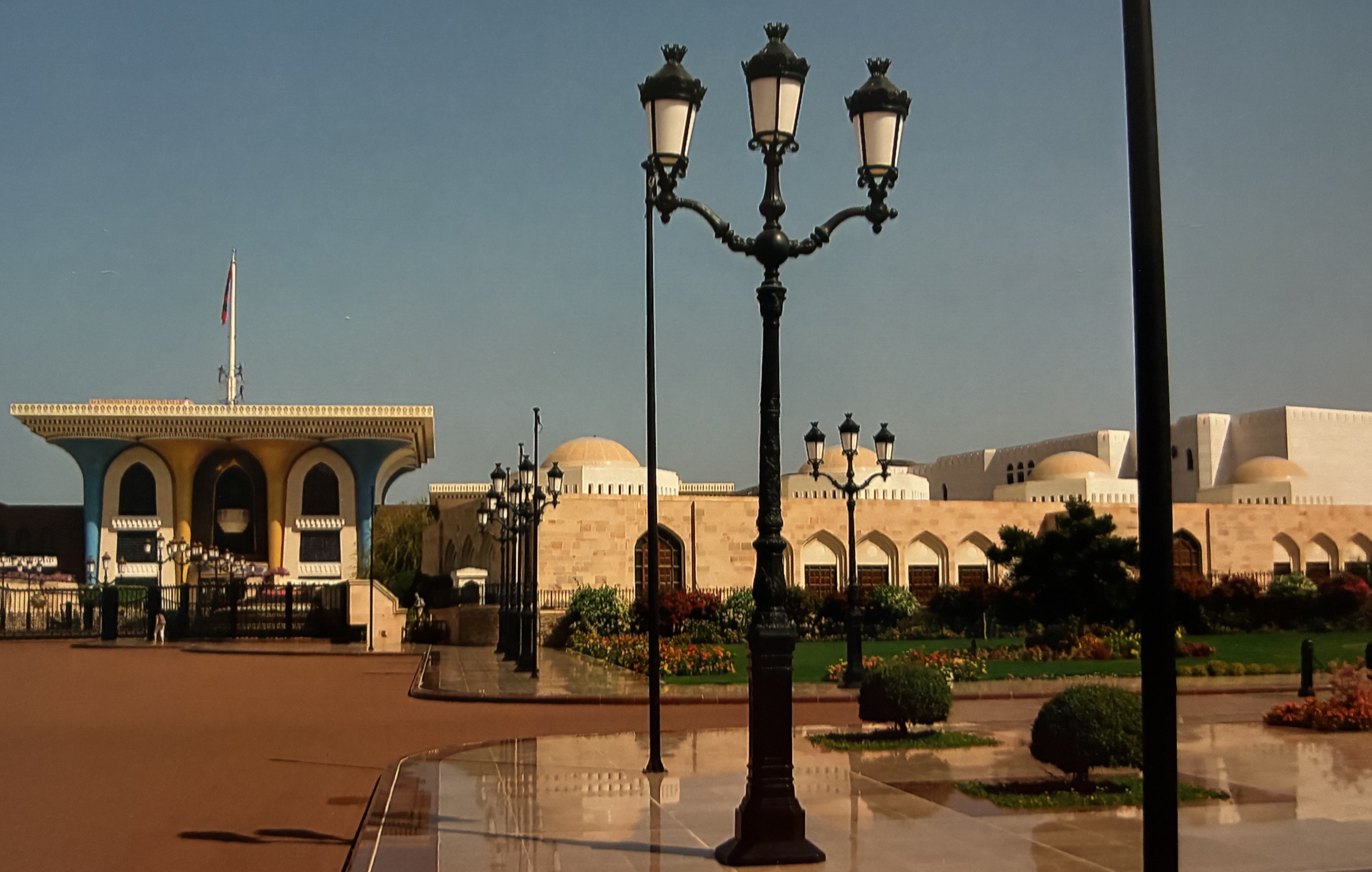
Taxi-driver Nasser arrives to take us to the modern palace of Sultan Qaboos. The Sultan prefers to live elsewhere and only uses the palace for formal occasions. Now in his 70s, he seems enlightened, using Oman’s relatively modest petroleum wealth to benefit the people (e.g., health and education) and decreeing that new structures must (a) not be high-rise and (b) be built in a style respectful of traditional architecture. As a result, Muscat and Oman in general have a pleasing city/townscape with buildings at a human scale and architecture appropriate to the culture and history without being copycat. A great contrast to Dubai, which has gone mad for increasingly fanciful skyscrapers and the biggest/grandest/tallest of everything.
We walk to Bait Al Zubair museum, built by a family which has advised the Sultan for generations. The museum is in four buildings, one of which recreates their city house, previously destroyed for a freeway. Their private collection of curved daggers, jewelry, traditional costumes and artifacts is housed in one building, where we spent so much time that we didn’t get to see the rest of the structures, except for one that offers a coffee bar and the re-creation of a more modest home with rush mats on the floors, sparse furniture and low doorways.
Nasser picks us up and drives us to the Al Bustan Hotel on the far side of Muscat for lunch. Built for a meeting of the Gulf Cooperation Council, it’s now a five-star hotel with lots of sloppily dressed Americans wandering around being uncouth while the Omani guests look noble in their traditional attire and act just like they look.
The geography of Muscat is like nothing we’ve ever seen. Barren, rocky mountains plunge into the sea, their valleys (wadis) opening into small bays where villages, now city districts, cling to what little flat land they can find. It’s particularly dramatic, with freeways carved through rocky passes connecting districts and inland areas. The Omanis plant trees, especially date palms, and flowering bushes like bougainvillea wherever they can, softening the harsh lines of the dry landscape.
We’re leaving the next day for an upcountry trek, so we spend the afternoon showering, packing and planning.
19 February
Up at 7:00 and away at 8:30 with driver Abu, who seems both genial and controlling. Not too flexible about what to do, despite Sofia saying in front of him that we were in charge of the itinerary.
Abu had a full career in the military (that explains the controlling bit) and now works as a tourist-driver to supplement his pension. He’s comfortable around foreigners, happy to explain, without being asked, that the Omani dishdasha has a tassel at the neck because it used to be perfumed. We are to learn a lot from him, but not always what we expected.
We load up his white four-wheel drive and set off through the barren mountains surrounding Muscat, mountains so sharp, so new-seeming, without the softening of erosion (e.g., the Appalachians), that it feels like we’re driving through the dawn of time. In such a bleak landscape, it’s easy to see why the ancient Omanis followed the trade winds to seek their fortune. We come to more gradually rising ground, until we’re through a shallow pass and into Nizwa Region.
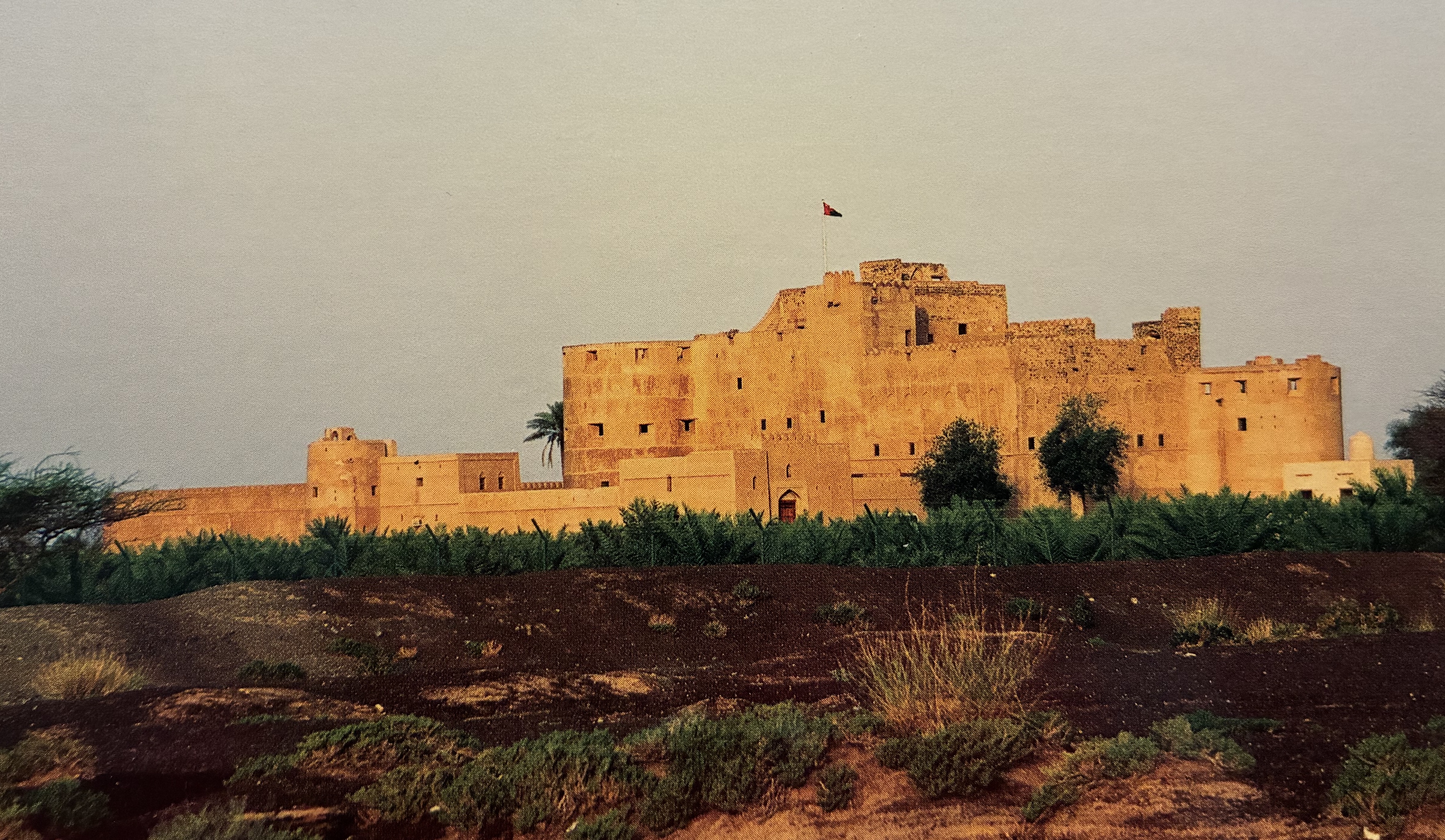 First stop is Jabrin (also spelled “Jabreen,” which gives a better idea of its pronunciation) Castle, built by Imam Bil’arubbin Sultan Al Ya’ruba in 1671, restored with help from UNESCO in 1983, now a World Heritage Site. Constructed of stone and adobe around a series of courtyards, Jabrin was a fortified residence of the Imam, who controlled a large part of what is now Oman. So much did he love his castle that his tomb is in a special area of Jabrin, which can only be reached by bending low to enter. The tomb and surroundings are surprisingly modest, just adobe with no decoration.
On the same ground level are giant storerooms for dates, which were collected in loose-weave sacks piled on top of each other so that the weight caused the juice to drip downward into runnels, where it was caught in jugs. They used date juice for everything from cooking to pouring, boiling-hot, onto invaders’ heads through slits in the upper floors.
Up above the storerooms are a council room, library, salons, sleeping quarters, bathing rooms for hygiene and for ritual purification before praying, a mosque and a school for boys. We explored up and down staircases, across wooden balconies connecting different wings, through high arches where hanging water jugs cooled and into low-ceilinged prison cells for an hour. But we could have spent even more time trying to encompass this complex and captivating structure.
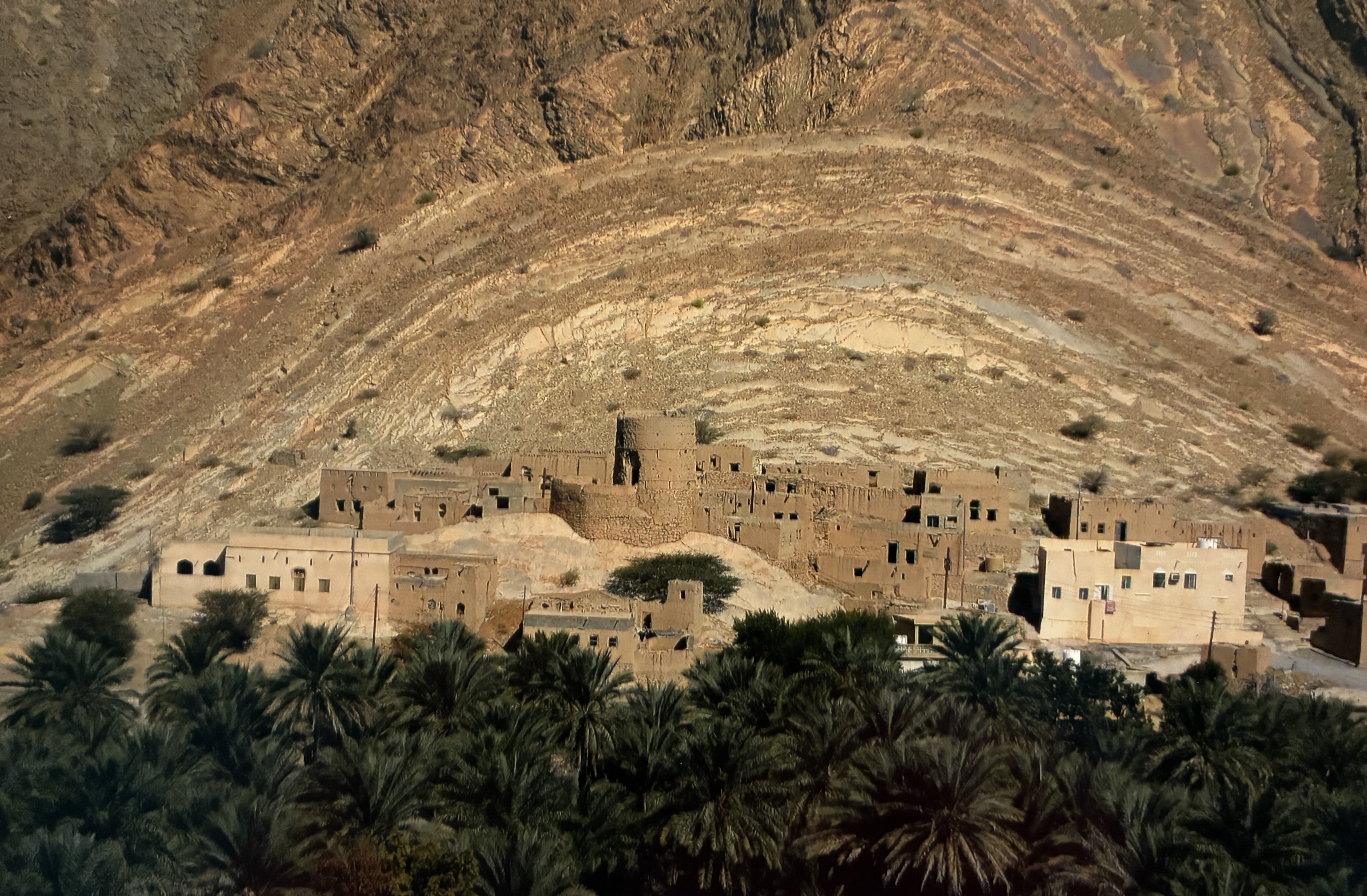 En route to Birkaut Al Mauz, we pass a village outlined against a typical geological formation — date palms in the foreground, then the village, then the curving layers of rock thrust up by some ancient force before humans walked this land. We travelled to Birkaut to see the ancient falaj (irrigation) system originally built by Persians who lived in Oman over 2000 years ago. I’m anxious to see if it’s similar to what I saw in Afghanistan, but the current system is mostly modern and built of cement, even if it does follow man-made water-courses from springs high in the mountains to the fields below. As we drive through the lovely shade of a date plantation, I do finally see an aqueduct made of mud brick with arches and perhaps a covered waterway above. I ask Abu to stop while I run into one of the arches and through a low doorway, up knee-high steps inside the arch to the exterior, and sure enough, the waterway is covered. Not exactly like Afghanistan, but enough like it that I can see how creative and far-reaching those long-ago Persians were, God bless ’em.
Over lunch, Abu initiates a discussion of our hotel for the night, arguing that he knows a much better place (and gets a commission??), right in Nizwa town. Our hotel is too far away, he argues. We counter that we made the reservation from Italy and gave the hotel our credit card number, so we can’t back out at this late hour. He is not happy.
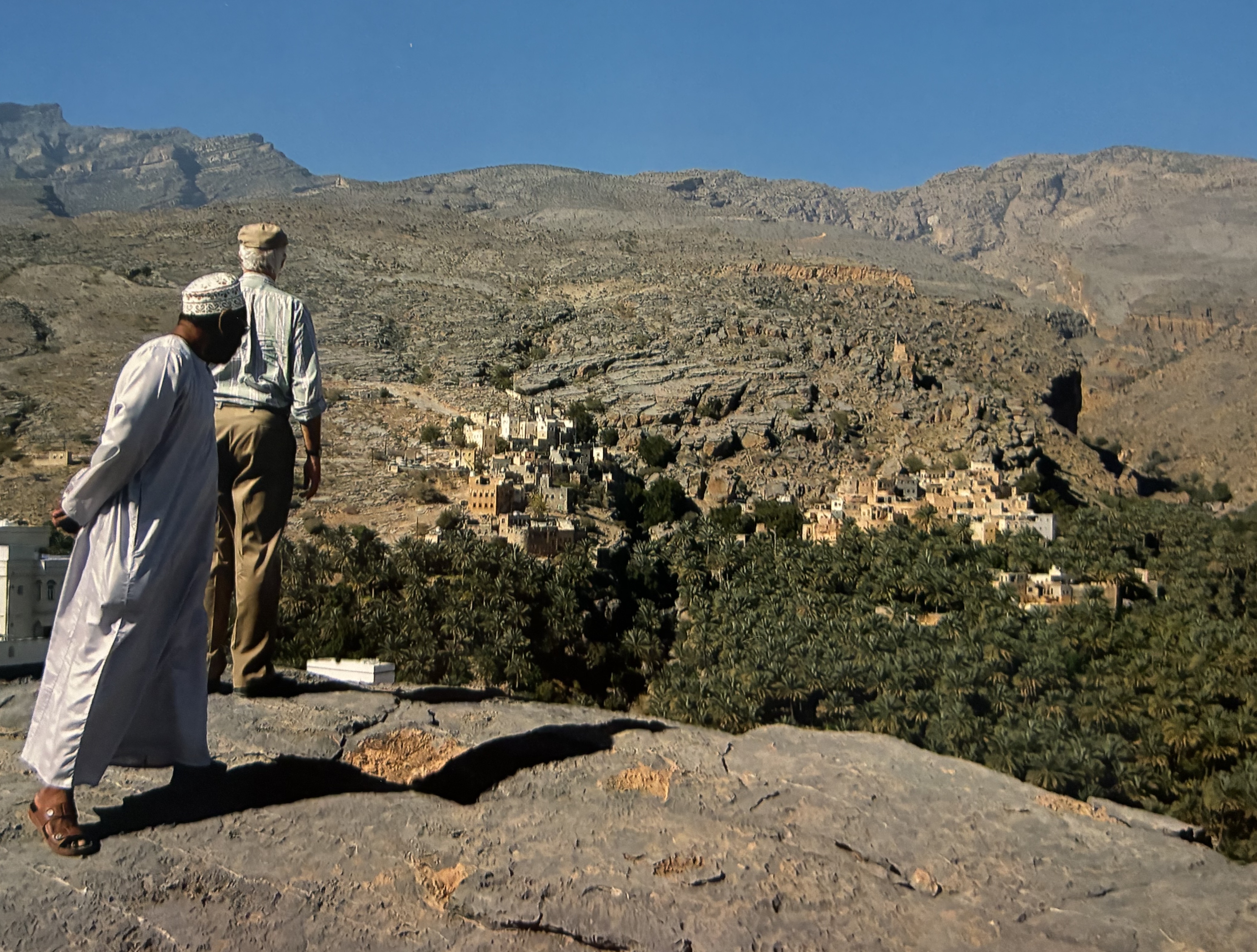 We drive on to Misfah, a real, functioning village clinging to the side of a gorge, first viewing it from afar. Once there, we discover its faraj system in place and operational. We walk down, down through steep, narrow streets, passing girls carrying plastic tubs of wet laundry home, to a hanging valley where they’re pollinating dates by hand. Young men climb barefoot up the palms and brush the female parts of the flowers with previously gathered pollen. What an amazing amount of work, and to think that until very recently, the date palm was the main food plant of the country.
Returning upward, we walk along the edge of a faraj, where Abu points to where the canals can be blocked/opened, asking us how the villages knew when to open and close the canals so every family gets its fair share of water. “How could they tell the time?” he asks. There must be a sundial somewhere in the village, I answer, and it was an oral culture, so everyone had a good memory and knew whose turn came when. Abu gives me a look of wonder. Then his look turns crafty. “And at night? How did they tell the time at night?” “With the stars,” says Russell, and Abu grins, points across the canyon to cairns of rock and explains that each one represents a family. When a specific star is over that cairn, the water course is changed.
Abu may be strong-willed, but he’s starting to let us do what we wish. He seems slowly to be understanding that we’ve done our homework, don’t need to be led around by the nose and enjoy going off the beaten tourist track. When he finds we know something, he’s a bit surprised, but he’s learning to supplement our knowledge, not over-ride it.
We continue to the top of the village, where Russell suffers a puncture wound from the sharp spine of a plant that’s leaning over the canal where we’re walking. Lots of blood; that’s both good and bad. At least the wound is getting washed out. When we get back to the car, I pull out my trusty first aid supplies, clean the wound with an alcohol-soaked cloth and put on a bandaid. Now we have to wait and see.
Back on the road, we turn toward the mountains. Before we ascend, we pass a police checkpoint in order (a) to make sure we have the required four-wheel drive, despite the road being asphalt all the way, and (b) we suspect, to check who’s going up there, after a rebellion in the 1950s. The region was off-limits until recently, but now spectacular views lead us up the exceptionally steep (no wonder we need 4×4), winding road until we reach the Saiq Plateau, cool and even greener than promised. As we drive along the flatter road, we see villages dotted here and there along the plateau and higher in the mountains.
Our hotel, the Sahab, is a cluster of local-stone buildings along the edge of a deep canyon, fitting nicely into the landscape. The gardens feature an infinity pool which seems to drop into the canyon and local plants scattered among stone walkways. We’re upgraded to a room with terrace overlooking the miles-long view. Very chilly once the sun goes down, so we’re happy to have our sweaters as we walk through the gardens to feast on local lamb chops by an open fire of mountain scents. Chocolate mousse for dessert. Aren’t we the lucky ones???
20 February
Russell’s hand is doing fine, so we head to breakfast without a care. In retrospect, we think that if we’d known at the time of booking what we know now, we’d have stayed another night up here and hiked around a bit. Such a lovely contrast to the dry plains below and the rocky coast of Muscat.
Down, down the twisting, turning steep road, seeing Pakistani workmen along the highway and wondering if they’re involved because of experience on the Karakoram highway — the 808-mile highway connecting Pakistan and China, the highest paved international road in the world. Years ago, I was lucky to travel a part of it while working on a project in Pakistan.
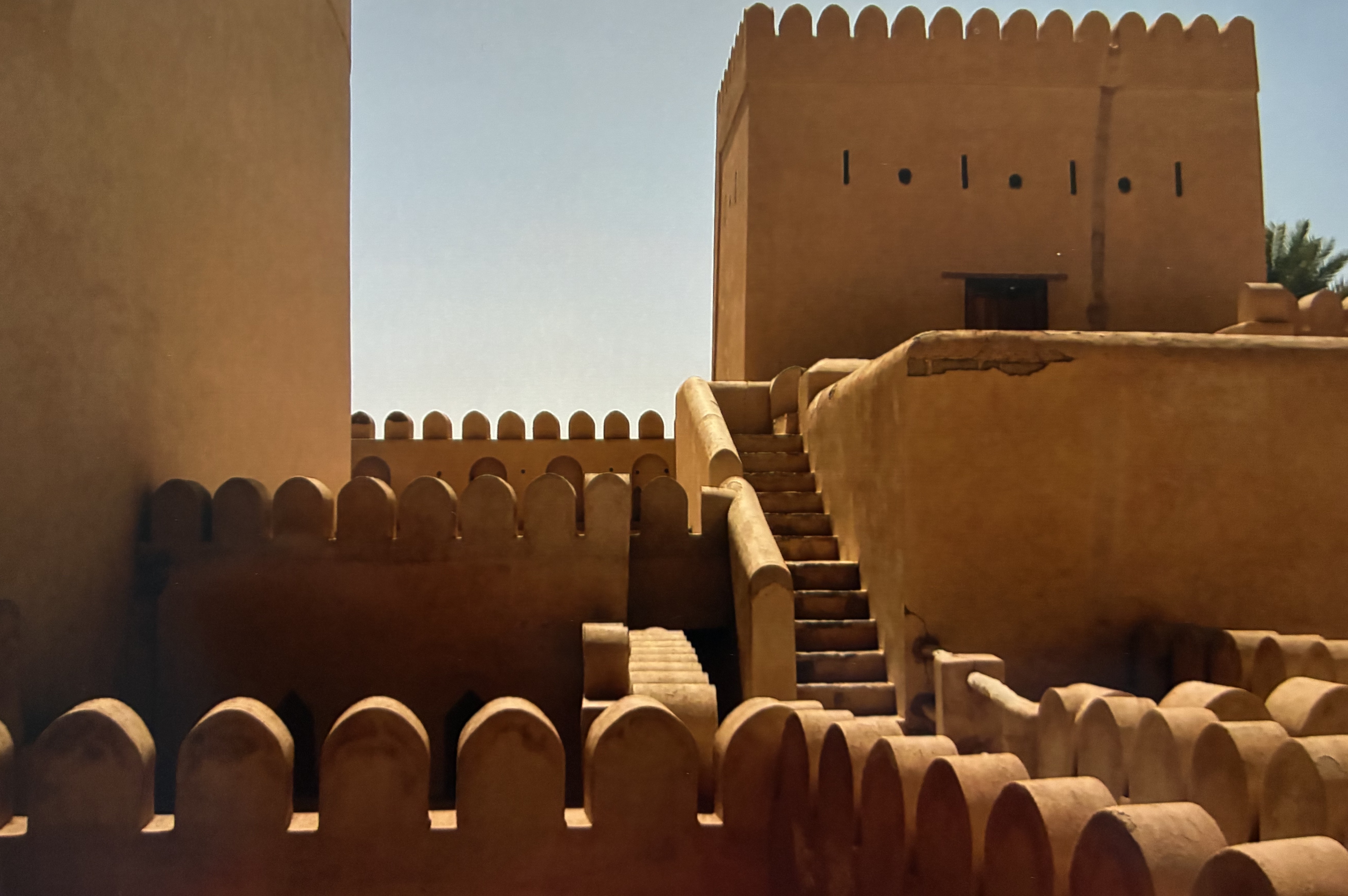 Arriving in Nizwa, we start at the souk, where Abu and I trade plant knowledge and he helps me find turmeric. What joy — almost impossible to find in Italy. Perhaps most interesting are the lemons dried hard as a rock which are used to flavor local dishes.
Then on to the fort, a good restoration but not as interesting as Jabrin.
Vignette at the fort:
Abu: “Do you know why they cut this small door into the big double doors at the fort entrance?”
RBS: “So it wouldn’t be necessary to open the big gates for just one or a few men.”
Abu, with knowing smile: “Yes, but why was that important?”
RBS: “It saves on the labor of men and the wear-and-tear of the gate. But it’s also useful in case one of your men is being chased. The small door can be opened and closed quickly, so those in pursuit can’t enter.”
Nancy: “The small door is called a ‘postern’ in English.”
Abu tries to smile.
He takes us away from the center of town to a local restaurant full of German tourists devouring the tired-looking buffet. R&I are trying to decide what to do when Abu taps me on the shoulder, whispers “Follow me,” and heads toward an arched doorway. We find ourselves in the section where the locals eat, each booth separated from others so families have privacy. We order off the menu and have a high old time sharing dishes and swapping stories.
Lo-o-o-o-ong drive to Wahiba Sands camp, detouring through Ibri, so Abu can show us his hometown. It’s all rather sad. The traditional part of town, including his old house, is now in ruins, and everyone’s living in the new town, mostly across the dry (at this time of year) river. Abu’s family farm is devastated for lack of water. He still owns the land and house but can’t do much to restore the un-restorable. On the outskirts of the new town, we pick up Abu’s youngest son, who was in a car crash last week, suffering a head injury. This is the first time Abu has seen him since the injury, but the teenager seems to be doing okay, just supposed to take it easy for another week. Abu confides that his oldest son (of 10!) was in a car wreck some years ago which damaged him for life. One has the impression that he’s dependent on Abu. Is this why Abu hasn’t been able to do anything with the family house and farm? And why he has to drive tourists around in what should be his retirement?