#70: Switzerland, July 2010
Let’s Do Impromptu!
July
The month of apricots, sun-scorched fields, and an excursion to eastern Switzerland.
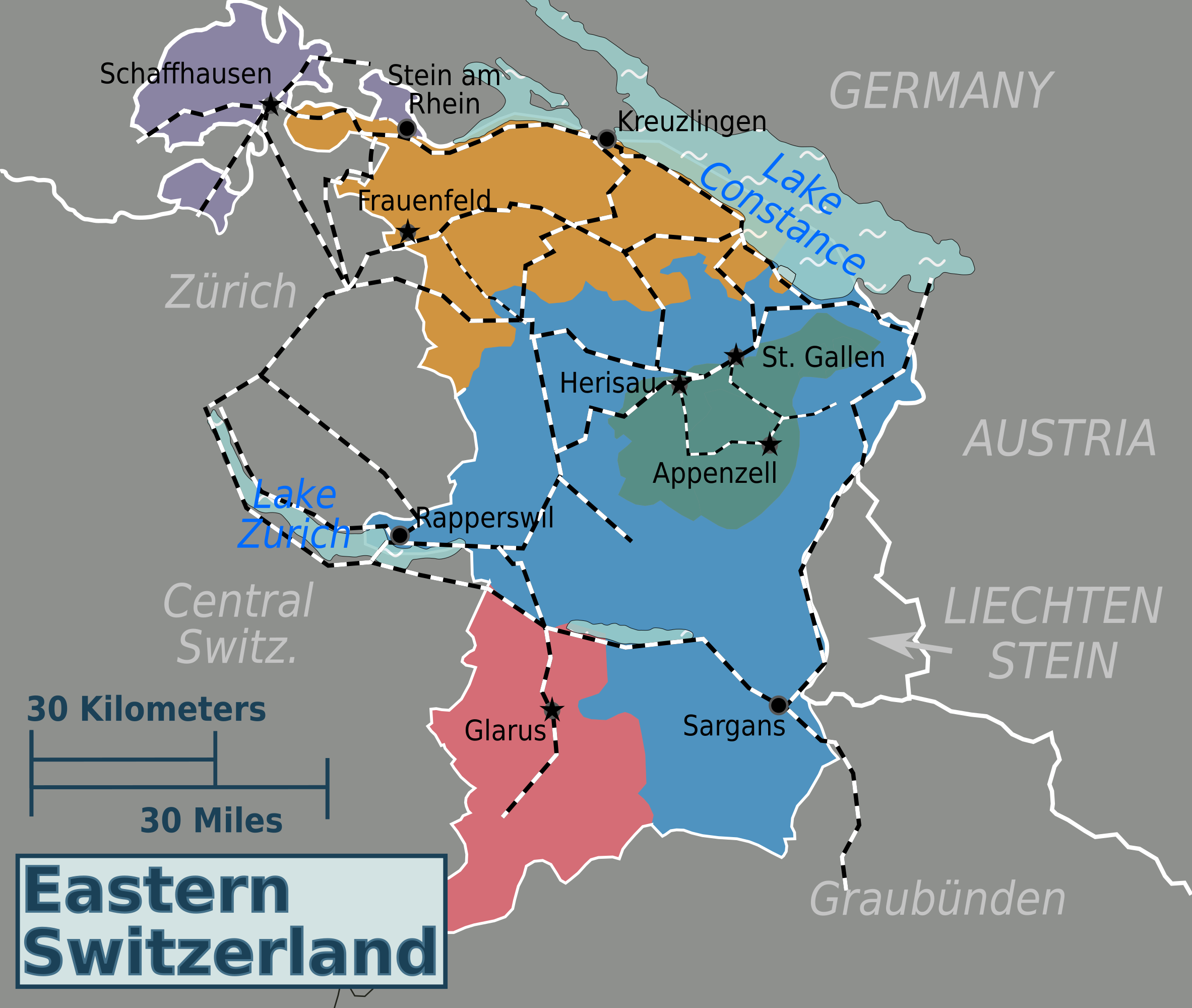
By User:Drat70 – Own work based on the following sources:Canton and country borders, lakes from File:Suisse cantons.svg by User:Pymouss44Train lines traced from File:Railwaysystem_Switzerland_2015.svg by de:Benutzer:Pechristener, CC BY-SA 4.0, https://commons.wikimedia.org/w/index.php?curid=56532828
All of Europe has been gripped by a terrible heat wave — nearly 100 degrees in Moscow and about the same in Italy. We decided the way to escape the horrific heat was to take an impromptu trip to higher altitudes, traveling by bullet train to Milan and Eurostar to Zurich, where we stayed overnight before continuing up the Rhine.
Switzerland offers a pass to tourists for 1, 3 or 15 days that gives ticket-free admission to every train, bus, funicular and ferry in the entire country, plus entry to 400 museums. And not just for routes linking major sites. Being able to travel as much as we wanted, wherever we wanted, for two weeks, without having to purchase a single ticket was a heavenly experience.
Our short train trip along the Rhine passed the biggest waterfall in Europe, a wide cascade of white water writhing like an animal desperate to get to the sea. Not long after, we were in Stein am Rhein (“shtine ahm Rhine”), where kids were jumping off the bridge into the swift river and adults paddling along in canoes. This was our first glimpse of something we noted again and again. The Swiss may be the most athletic people in the world, hiking, biking and swimming seemingly everyday. Not once did we see a truly fat person; a few chubbies here and there, but they were on bikes or hikes and more fit than this skinny gal, that’s for sure.
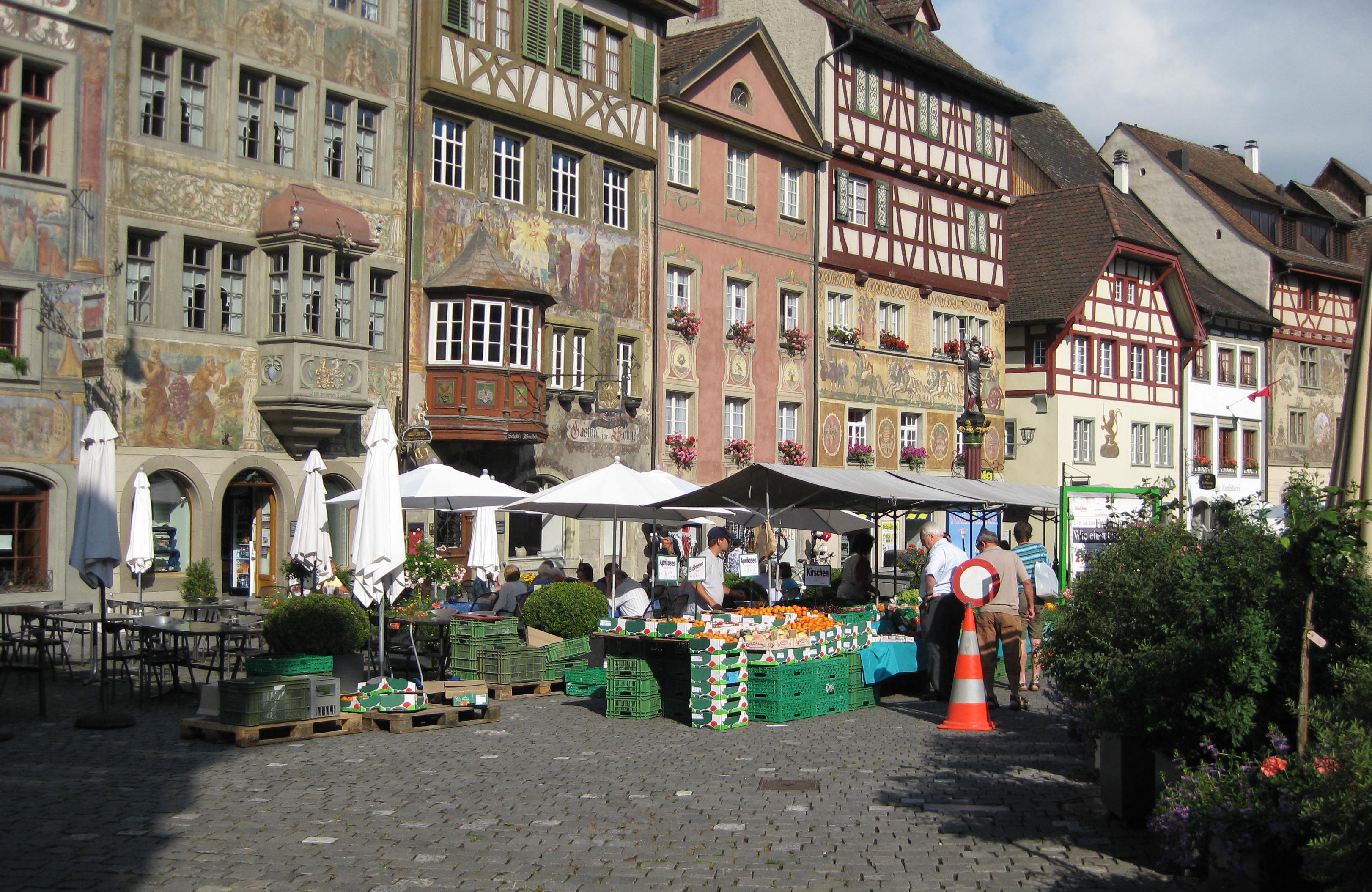 Stein am Rhein turned out to be one of my favorite places, a village of half-timbered medieval-16th century houses, many with elaborate frescoes on external walls. Quaint and charming — overused words, but if ever they applied to anyplace, they apply to SaR. Happily, our hotel was created by joining several of these old houses, and we had only to walk out the front door to be in the main plaza, gateway to all the sights and shopping.
Good sightseeing, too: a castle on a hill; a 14th century Benedictine monastery by the river, a burger’s house restored so you could see how the middle class lived, including a barn with cows and chickens across a rear courtyard (right in the center of town!). Lots of old churches on both sides of the Rhine, each featuring something different and interesting.
Mementos of all types were displayed in enchanting shops along cobbled streets — temptations for gardeners and chocoholics; hand-crafted items in wood, metal, textiles and ceramics; kitsch and art, all on view in enticing displays. We always take small gifts back to Amelia friends. But this was the first stop, and I assumed I’d see the same sort of thing over and over. WRONG! This was the first and last time I saw articles of such quality. I ended up buying a bunch of boxes of Swiss chocolates at our final destination, berating myself for being such a dummy.
After two days in Stein am Rhein, we were ready to move on to Steckborn (“shteckborn”). We’d planned to go by train, but once we found out there were ferries up and down the Rhine and that the boat dock was lots closer than the train station, we decided to go by boat. What a lovely voyage, as the ferry crisscrossed the river from one little village to another until we finally saw the towers of the Turmhof, formerly belonging to the abbots of Reichenau (see below). It turned out to be quite a hike to our hotel, but well worth it, because of its location on a peninsula jutting into the Untersee, an extension of Lake Konstanz (if you’re German, or the “Bodensee,” is you’re Swiss). From there, we could easily visit, by train or ferry, all the nearby sights.
We spent one day in Konstanz, a city which has passed back and forth between the Germans and the Swiss through the ages.
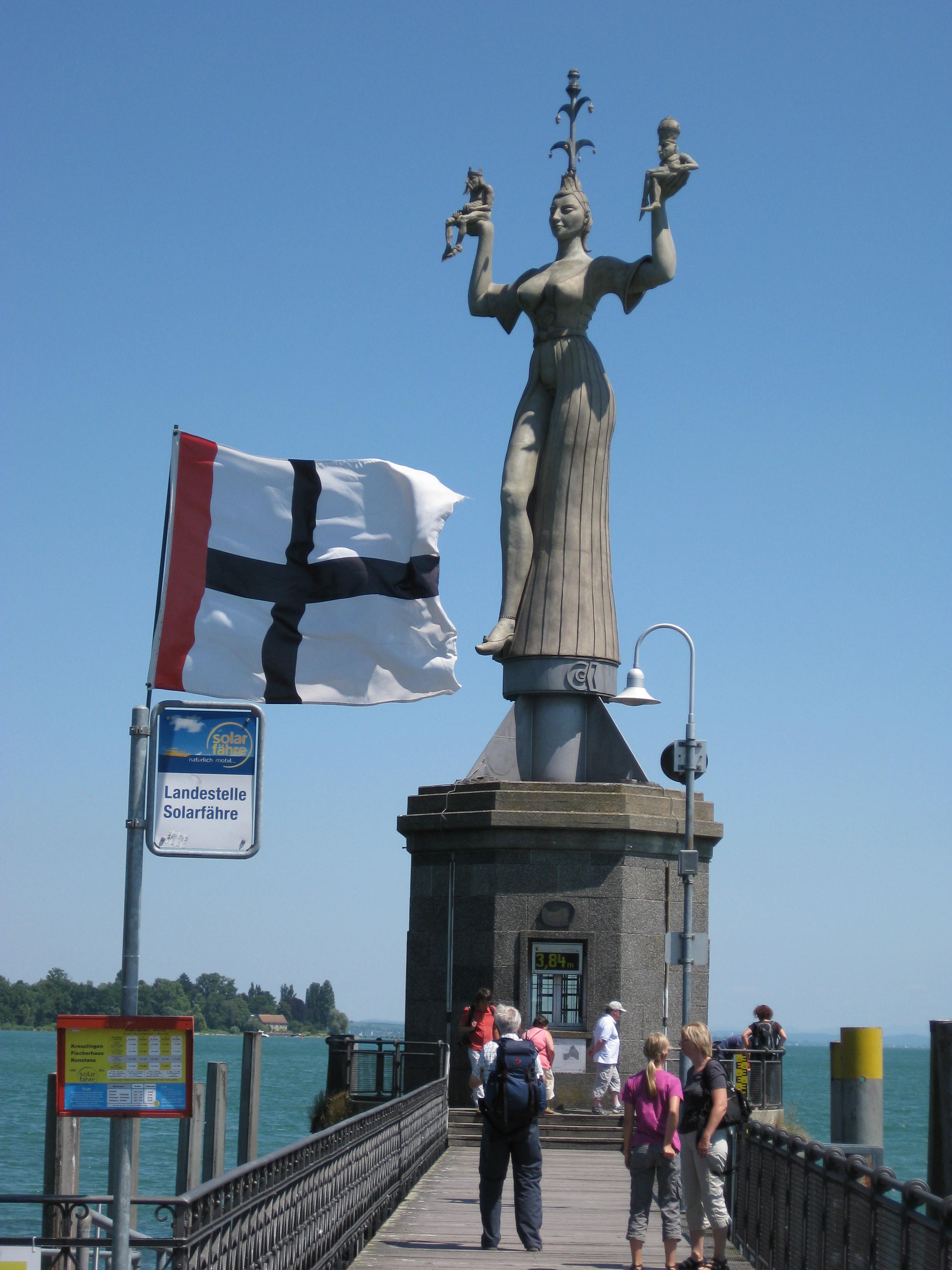 Konstanz is now in German hands, so we crossed an invisible border and had to use euros instead of Swiss francs for the few hours we were there. We got a tourist-office map for a walking tour featuring old houses, city gates, churches and whatnot. Surprised to discover that, despite our having an English version, we sometimes found it nearly impossible to locate the next site on our tour and even local folk didn’t know where that building was. A city filled with history, and its own citizens don’t know it??? Perhaps the most important building is the Council House, where in 1417 the church fathers finally agreed on one Pope instead of the then-current three. This lovely old building overlooks the harbor, with its modern, revolving statue of a giant, bare-breasted woman holding two figures representing worldly and religious power. The same artist, Peter Link, created a fountain in the center of the city, which was equally a social commentary, but less heavy-handed.
Another day, we took the ferry to the island of Reichenau (“raikh-uh-now”), which contains three World Heritage churches. Ah, but there’s a catch: the cross-island bus arrives at the most famous/important church (c. 900 a.d.) at 2:10, but the tour starts at 2:00 and 4:00. The last ferry leaves at 5:30, and the return bus doesn’t coordinate with that departure. If you don’t get to the church when the 2:00 tour starts, they will not be at all flexible. AND these little facts are not to be found on the tourist info board by the ferry landing. AND the next bus to the second-best site doesn’t leave for another hour, so you stand in the sun feeling the back of your neck fry while you wait. But life goes on, and we did enjoy seeing the cathedral and the former monastery, which are open all day. In 840 a.d., an abbot of the monastery wrote the first gardening book (poem, actually) in Western history, and you can visit a recreation of his garden (funnily enough, not so different from ours — lavender, sage, lilies, chamomile, santolina, etc.). No time to see the third church, so we got on the 5:30 ferry and returned to our hotel for an excellent dinner.
Despite the unexpected difficulties visiting Reichenau, we were pleasantly surprised by how friendly the Swiss were and how well we ate. Not just the traditional bratwurst and potatoes in various forms, but inventive use of salads with meats, and everything else from starters to main courses. The people and the food don’t have that reputation, but Switzerland gets our F/F Award (Friendly/Food).
For our final day by Lake Konstanz, we took the train to St. Gallen, a city originating in 612, when the Irish monk Gallus founded his hermitage there. A large religious complex grew from that modest beginning, including the cathedral and legendary library, a repository of learning when most of Europe was very dark indeed. (I must say, though, that the architecture of both, as they now stand, was a turnoff for me. Baroque: the Church Decadent and the Taste Wealth-Flaunting.) The city has preserved much of the old town within its modern neighborhoods, and it was fun just to stroll the narrow streets in search of a cafe for a light lunch.
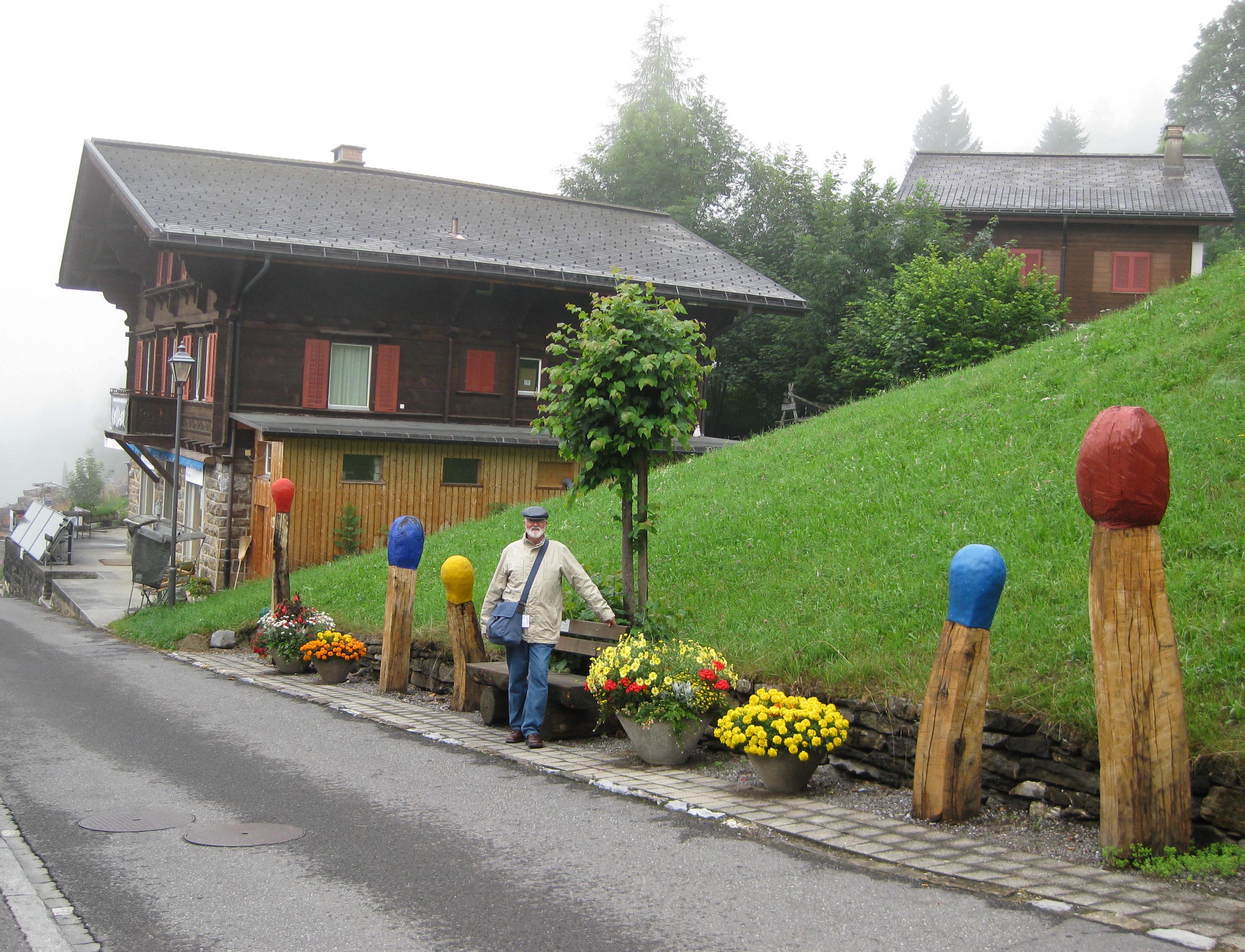 The next morning found us back on the train and heading for Lintel, where we took a funicular 1000 feet up to Braunwald, an Alpine village on a plateau 4000-5200 feet above sea level. From our traditional chalet-hotel, built in the thirties and still in the same family, we could see snow-capped mountains above. While we were there, the skies opened, and the snow level came down to 6500 feet, which didn’t look far away at all. We dressed in layers and hiked here and there on the plateau, enjoying the cool temps (teens and below). I must confess to my love affair with Niki, a palomino pony who pulls a wagon with supplies, luggage and sometimes guests from the funicular terminus up to the hotel. Although I journeyed on foot, I was still pleased to make her acquaintance.
After three nights at that altitude, we left our luggage with Niki and her stalwart human and walked down to the funicular for the ride to the train station, checking that we had the right information about our next destination. Soon after, as promised, our luggage came down on the funicular, and we got on the train once again, this time to Lake Walensee (“vall-en-zee”).
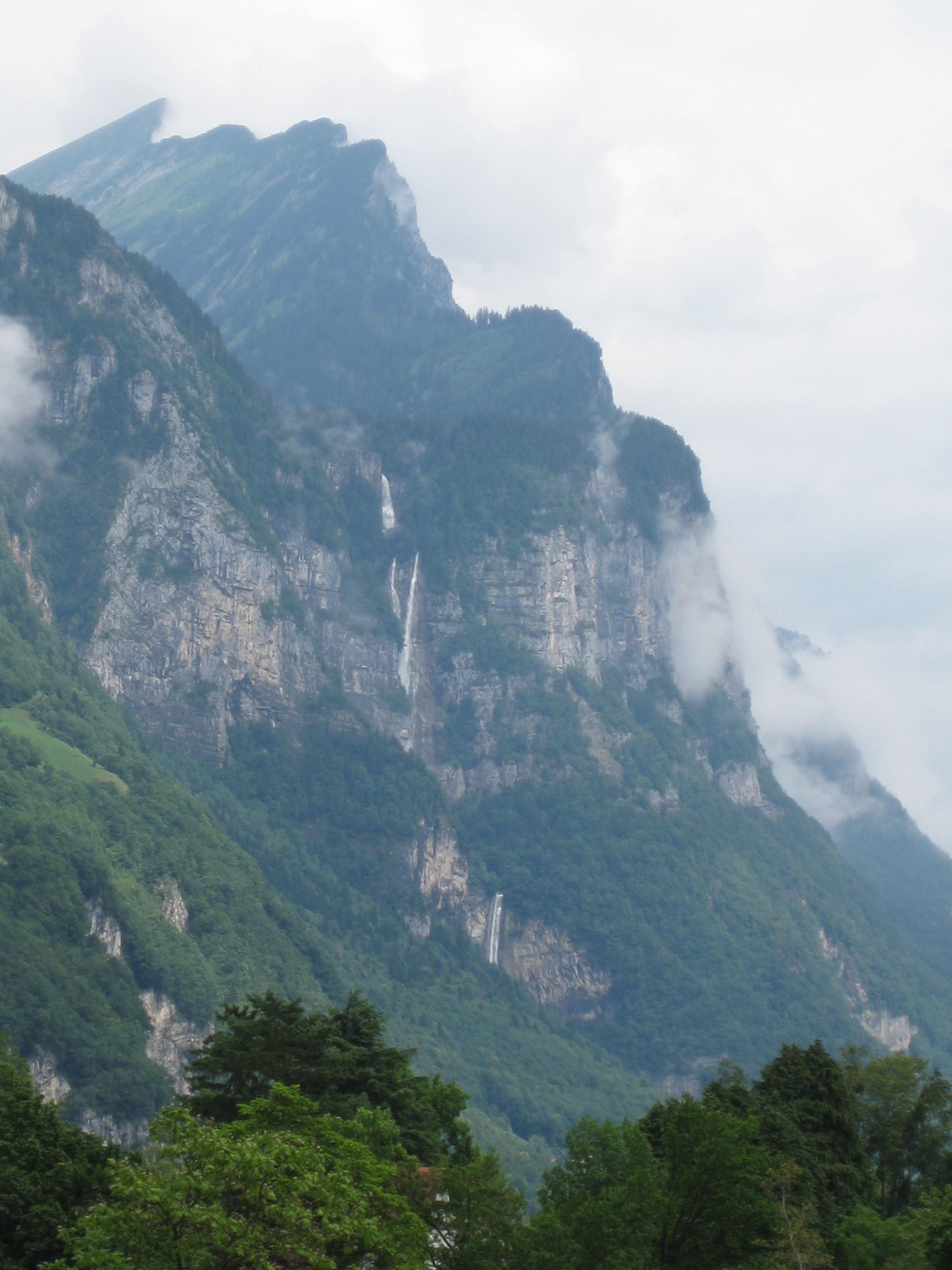 Not only did we have a lakeside hotel dating back to the 14th century, they upgraded us to their best room, complete with a bathroom big enough to host a party. From our windows, we could see a tall, thin waterfall cascading down a mountainside, as well as a fountain in the lake which turned into a drifting rainbow in the afternoon sun. We took a ferry ride on the lake, remarking on the sheer granite cliffs which fall directly into the water and isolate tiny villages which rise wherever there’s a bit of sloping land. The next day, Russell had planned to ride the cable car up onto the massif for what was billed as a marvelous view (not this girl: heights are the opposite of a thrill for me), but low-lying clouds promised to obscure the experience. So we took the train three stops to the town of Nafels (“nay-fells”), where we visited a fascinating museum housed in a palace built by the commander of the Swiss Guards in 1640s France. Turns out soldiers were one of the great exports of this region, along with textiles, and we passed a pleasant couple of hours exploring both traditions.
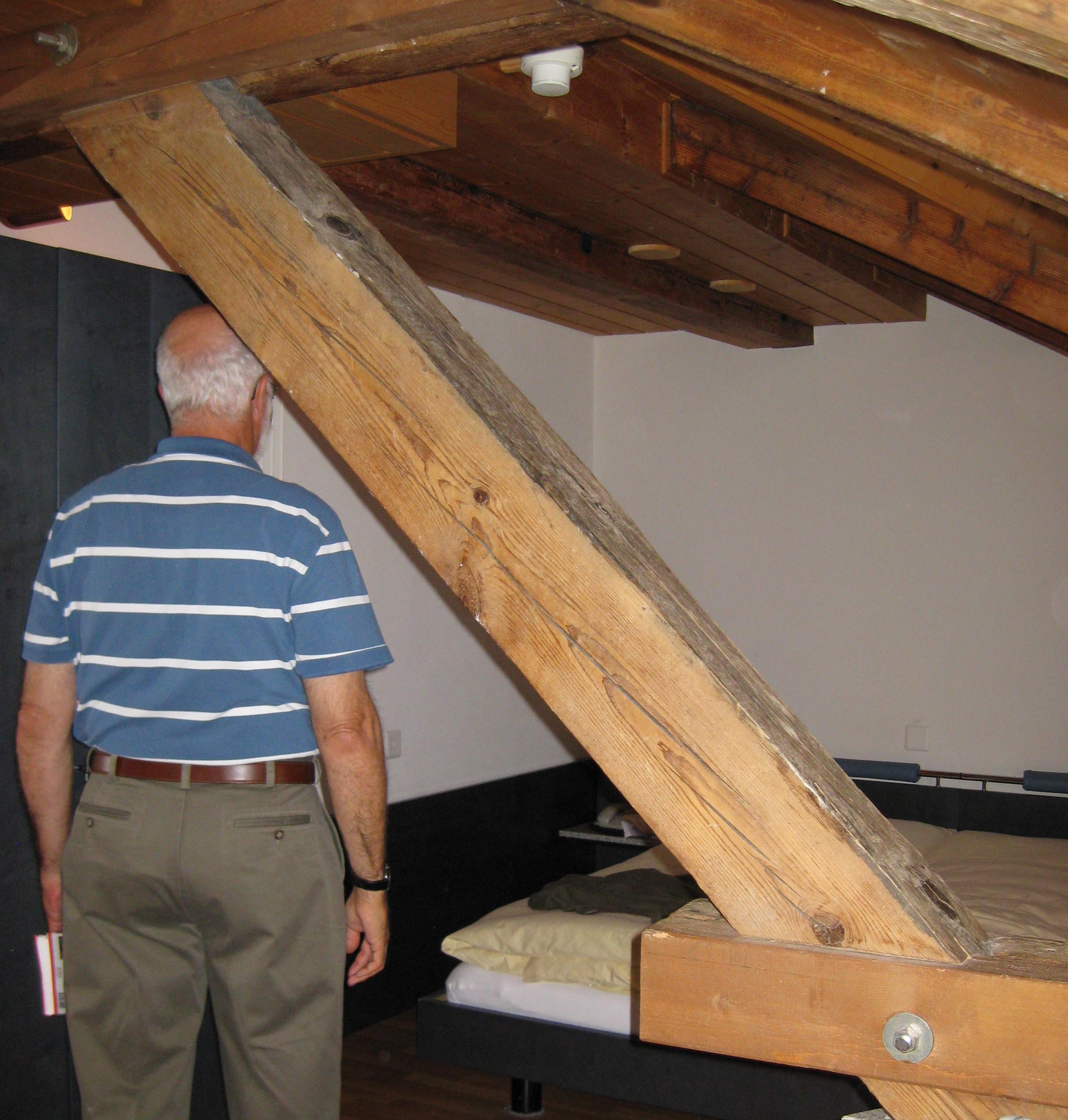 Time to get back on the train, this time to the city of Chur (“coor”), founded by the Romans in the 1st century BC, with even earlier stone-age settlements inside the modern city’s footprint. Our hotel was again a renovation of several old houses, but disappointing despite our being upgraded. Our “deluxe” room was up under the eaves. We spent half the time hunched over so as not to bump our heads (when we weren’t actually doing so). Russell mentioned this problem at the front desk, and the clerk hastened to tell him that using the former attics was all the rage in Chur hotels, but the subtext was clear: we weren’t the first to complain. Chur is known for its shopping, and I spent some pleasurable time in stores while RBS finally got to take his cable car up into the heights.
Lots of train rides, but the best for last. We took the Bernina Express, the highest train in Europe, over ver-r-r-ry tall (300 feet) bridges and through tunnels that literally looped upward, across a pass over 7300 feet high, past glaciers and sea-foam-green lakes, down a viaduct that looped the loop (although keeping the train fairly horizontal). It was the 100th anniversary of the Express, and it had recently been awarded World Heritage status, so it was an even more special trip than we had imagined. (I should add that its sister train, the Glacier Express from St. Moritz to Zermatt derailed a few days before we were to travel. Several wounded and one killed — a good reminder that modern tourism isn’t always as simple as it seems.)
We ended in Tirano at the foot of the Italian Alps. Another hotel upgrade, this time to a suite, although I confess I don’t know what hotels mean by the term these days, when a “suite” seems to be just a large room. A good sleep, then via a regional train to Milan, traveling along one of the arms of Lake Como for at least an hour, then the bullet to Rome, a regional back to Orte and a taxi home. Yes, lots of trains, but what a wonderful trip!
And what a nice homecoming. There’d been a storm a couple days before, and the daytime temps had fallen to the high 70s. It felt like we were back in Switzerland. But the storm also took out our phone line, confirming we were in Italy for sure.